
Search is changing faster than ever. People no longer rely only on traditional Google results to find products, services, businesses, and answers. They are increasingly using AI-powered search experiences, voice assistants, featured snippets, and conversational platforms to discover information.
This shift has introduced three important digital marketing strategies: SEO, AEO, and GEO.
SEO, or Search Engine Optimization, focuses on improving a website’s visibility in traditional search engine results. AEO, or Answer Engine Optimization, focuses on creating content that directly answers users’ questions. GEO, or Generative Engine Optimization, is designed to improve a brand’s visibility within AI-generated answers and conversational search experiences.
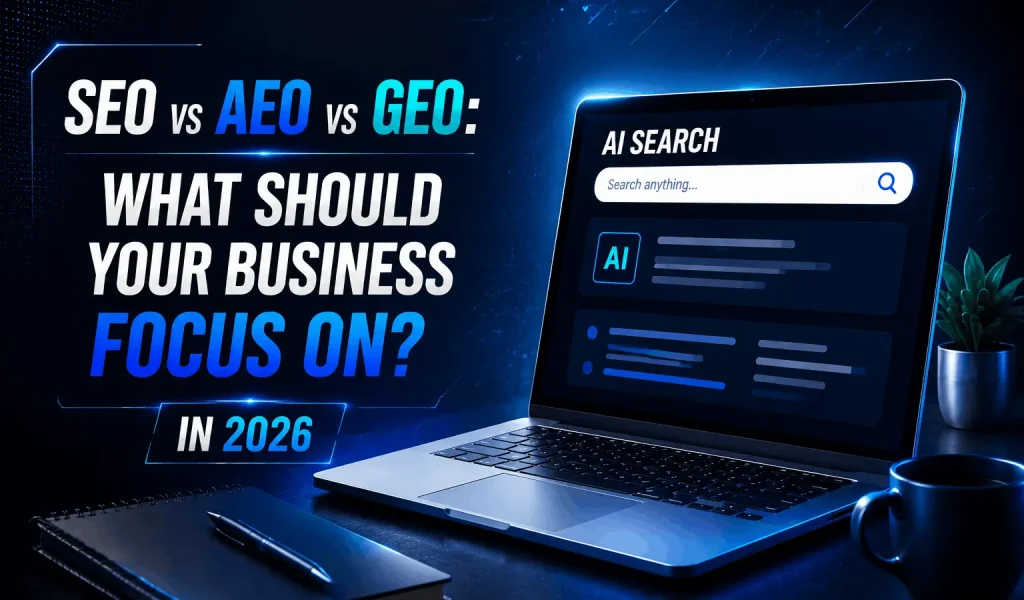
So, when comparing SEO vs AEO vs GEO, what should your business actually focus on?
The answer is not necessarily one or the other. A successful digital strategy in 2026 should combine these approaches according to your business goals, audience, industry, and search behavior.
What Is SEO?
Search Engine Optimization is the process of improving a website so that it can achieve better visibility in search engine results.
Traditional SEO involves several areas, including:
- Keyword research
- On-page optimization
- Technical SEO
- Content creation
- Internal linking
- Website performance
- Mobile optimization
- Backlink development
- Local SEO
- User experience
The primary objective is to help search engines understand your website and determine that its content is relevant and useful for particular searches.
For example, if you operate a web development company in Lahore, your SEO strategy might target searches related to web development services, website design, WordPress development, ecommerce development, and local web development companies.
SEO remains essential because search engines still generate significant amounts of traffic for businesses. A strong organic presence can help businesses attract users who are actively searching for their products or services.
What Is AEO?
Answer Engine Optimization focuses on optimizing content so that it can provide direct answers to users’ questions.
Instead of targeting only traditional rankings, AEO considers how search engines and answer-focused systems extract information from websites.
Users frequently search in the form of questions, such as:
- What is SEO?
- How much does website development cost?
- How long does SEO take?
- What is the difference between SEO and AEO?
- Which digital marketing strategy is best for small businesses?
AEO encourages businesses to structure their content around these questions and provide clear, concise, trustworthy answers.
Frequently asked questions, conversational headings, structured content, lists, definitions, and clearly organized information can all support an effective AEO strategy.
The goal is simple: make your content easy for search systems to understand and easy for users to consume.
What Is GEO?
Generative Engine Optimization is focused on visibility within AI-generated search experiences.
Modern users can ask conversational questions and receive synthesized answers rather than simply browsing a list of links.
Generative search systems may combine information from multiple sources before producing an answer. This creates a new challenge for businesses: being visible isn’t only about ranking a webpage anymore. Businesses also need to establish credibility and publish information that AI systems can understand and potentially reference.
GEO focuses on areas such as:
- Demonstrating expertise
- Publishing original and useful content
- Building topical authority
- Maintaining accurate business information
- Strengthening brand visibility
- Creating well-structured content
- Supporting claims with reliable information
- Answering specific user questions
- Building a consistent online presence
GEO is therefore closely connected to traditional SEO and content strategy, but its focus extends toward AI-driven discovery.
SEO vs AEO vs GEO: What Is the Difference?
The easiest way to understand the difference is to look at the primary goal of each strategy.
SEO: Improve visibility in traditional search results.
AEO: Provide direct answers to user questions.
GEO: Improve visibility and representation within generative AI search experiences.
These strategies overlap significantly.
A well-optimized article can potentially rank in Google, appear as a useful answer for a question, and provide information that AI systems can understand.
This means businesses shouldn’t necessarily create three completely separate content strategies.
Instead, they should build one strong content foundation and optimize it for different types of search behavior.
Why SEO Still Matters
With all the discussion around AI search, some businesses may assume traditional SEO is becoming irrelevant.
That would be a mistake.
SEO provides the technical and content foundation required for online visibility. Search engines still need to crawl, interpret, index, and evaluate websites.
Technical performance, relevant content, internal links, website structure, mobile usability, and authority continue to matter.
SEO also supports AEO and GEO because well-structured and authoritative websites are easier for search systems to understand.
For most businesses, SEO should therefore remain the foundation of their digital marketing strategy.
Why Businesses Should Invest in AEO
AEO is particularly useful for businesses that receive question-based searches.
Instead of simply writing an article around a keyword, businesses can create content that addresses the problems their customers actually have.
For example, a digital marketing agency could create sections answering:
What does a digital marketing agency do?
How much does digital marketing cost?
How long does SEO take to produce results?
Is SEO better than paid advertising?
This approach can make content more useful while also increasing the chances of appearing for conversational searches.
AEO can also improve the user experience because visitors can quickly find answers without reading an entire page.
Why GEO Is Becoming Important
AI-powered search is changing how users discover information.
Instead of opening several websites and comparing information manually, users can ask an AI system to summarize options, explain a concept, or recommend solutions.
For businesses, this creates another layer of online visibility.
A company needs to become a credible source of information across the web. This means publishing useful content, demonstrating expertise, maintaining accurate information, and building a recognizable digital presence.
GEO should not be viewed as a replacement for SEO. Instead, it should be treated as an extension of a broader search visibility strategy.
Should Your Business Focus on SEO, AEO, or GEO?
For most businesses, the best answer is all three, but in the right order.
Start with SEO.
Your website needs a technically sound foundation, relevant content, good site architecture, and a clear understanding of your target keywords.
Then incorporate AEO.
Identify the questions your customers ask and create straightforward answers. Use descriptive headings, FAQs, lists, definitions, and conversational language where appropriate.
Finally, strengthen your GEO strategy.
Develop authoritative content, demonstrate expertise, publish original insights, maintain consistent business information, and create content that can be easily understood by AI-powered systems.
This creates a more complete search strategy rather than focusing on a single platform.
How to Build an SEO, AEO and GEO Strategy
1. Understand Your Audience
Start by identifying what your customers search for.
Look beyond individual keywords and investigate their problems, questions, concerns, and purchase intentions.
2. Build Topic Clusters
Instead of publishing random articles, organize your website around important topics.
Create comprehensive pillar pages and supporting articles that answer related questions.
This can help establish topical relevance and make your website easier to navigate.
3. Create Helpful Content
Content should solve a real problem.
Avoid producing articles simply to insert keywords. Search engines and users increasingly value content that demonstrates knowledge and provides genuine value.
4. Answer Specific Questions
Include relevant questions throughout your content.
Provide direct answers before expanding into additional explanations. This structure works particularly well for informational searches.
5. Improve Technical SEO
Make sure your website is fast, mobile-friendly, crawlable, secure, and logically structured.
Technical problems can prevent even excellent content from performing effectively.
6. Demonstrate Expertise
Show visitors why they should trust your business.
Author information, professional experience, original research, case studies, clear business information, and useful insights can all strengthen credibility.
For businesses seeking professional digital growth, WDC Lahore focuses on combining modern SEO practices with content and digital marketing strategies designed around changing search behavior.
7. Monitor Search Performance
Track organic rankings, impressions, clicks, conversions, featured-result opportunities, and traffic patterns.
Your strategy should evolve based on actual performance rather than assumptions.
The Future of Search Visibility
The future of search is unlikely to belong exclusively to SEO, AEO, or GEO.
Instead, these strategies will increasingly work together.
A business may attract a customer through a traditional Google search, answer their question through optimized content, and later become visible to that same customer through an AI-generated recommendation.
This means businesses should think beyond rankings.
The bigger objective is search visibility across the entire customer journey.
Companies that consistently publish useful information, build authority, optimize their websites, and understand changing search behavior will be better positioned to compete.
Conclusion
The SEO vs AEO vs GEO debate should not be about choosing one strategy and abandoning the others.
SEO provides the foundation for search visibility. AEO helps businesses answer users’ questions more effectively, while GEO prepares brands for an increasingly AI-driven search environment.
For most businesses, the strongest approach is to start with solid SEO, integrate AEO into content creation, and gradually develop GEO practices.
The goal is not simply to rank higher.
The goal is to make your business discoverable, understandable, credible, and useful wherever your customers are searching.
As search continues to evolve, businesses that adapt their content and digital marketing strategies will have a stronger opportunity to remain visible and competitive.
FAQs
1. What is the difference between SEO, AEO, and GEO?
SEO focuses primarily on improving visibility in traditional search results. AEO focuses on providing direct answers to user questions, while GEO focuses on improving visibility within AI-generated and generative search experiences.
2. Is SEO still important in 2026?
Yes. SEO remains an important foundation for online visibility. Technical optimization, quality content, website structure, authority, and user experience continue to influence how websites are discovered.
3. Is AEO replacing SEO?
No. AEO complements SEO rather than replacing it. Businesses can use SEO to build search visibility while using AEO techniques to answer specific questions more effectively.
4. What does GEO mean in digital marketing?
GEO stands for Generative Engine Optimization. It refers to strategies designed to improve a brand’s visibility and representation within AI-powered search and generative answer experiences.
5. Which is better, SEO or GEO?
Neither is universally better. SEO remains the foundation for website visibility, while GEO addresses the growing importance of AI-generated search. Businesses should generally combine both.
6. How can I optimize my website for AEO?
Create clear answers to relevant customer questions, use descriptive headings, structure information logically, add useful FAQs, and provide concise answers supported by detailed explanations.
7. How can businesses prepare for AI search?
Businesses should publish accurate and useful content, demonstrate expertise, maintain consistent business information, build topical authority, and ensure their websites follow strong technical and content SEO practices.
8. Does GEO replace traditional content marketing?
No. GEO works alongside content marketing. High-quality, original, useful content remains important because it gives search systems and users meaningful information to understand and evaluate.
9. Should small businesses invest in AEO and GEO?
Yes, but the priority should depend on their audience and goals. Small businesses should establish a strong SEO foundation first and then incorporate AEO and GEO practices into their content strategy.
10. What should a business focus on first?
For most businesses, start with technical SEO, keyword research, helpful content, website structure, and authority. Once the foundation is established, incorporate AEO and GEO into the overall search strategy.