
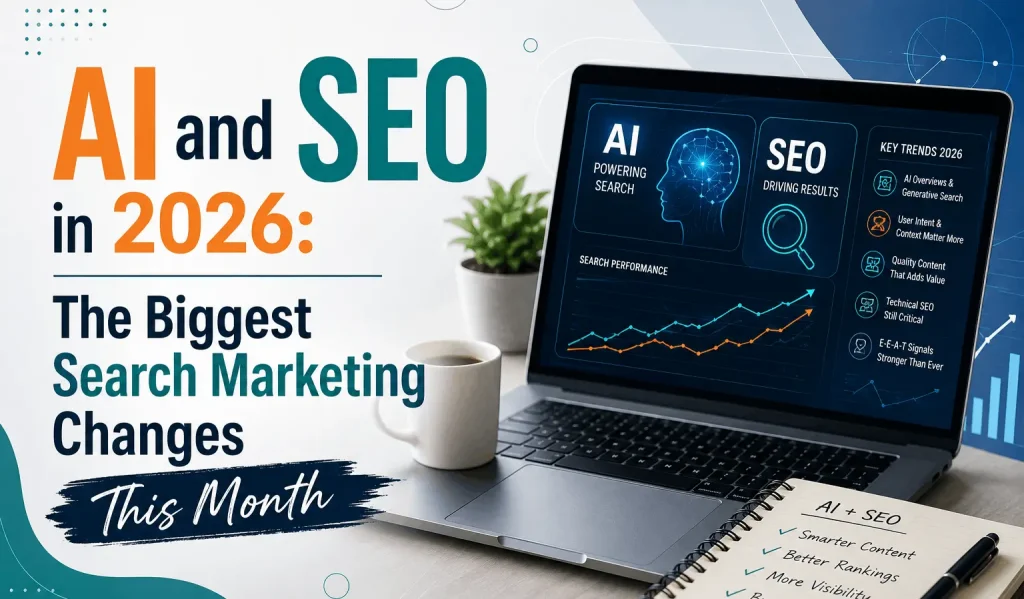
Search marketing is changing faster than ever. In 2026, businesses are no longer optimizing only for traditional Google rankings. Search is increasingly influenced by artificial intelligence, conversational queries, AI-generated answers, and new ways of discovering information.
The latest developments in August 2026 make this shift even clearer. Google recently completed its August 2026 Spam Update, while AI-powered search experiences and advertising tools continue to expand. Google has also been developing more advanced AI features for Search, including AI Mode and agentic search experiences.
For businesses, this means SEO is not disappearing. Instead, AI and SEO in 2026 are becoming increasingly connected. Websites need strong technical foundations, useful content, trustworthy information, and a strategy designed for both traditional search results and AI-powered search experiences.
Google Completes Its August 2026 Spam Update
One of the biggest search marketing developments this month is Google’s August 2026 Spam Update.
The update began on August 18 and was completed on August 21, 2026. Google stated that the update applies globally and across all languages.
Google did not provide a detailed list of the specific spam techniques targeted by this update. However, website owners should continue following Google’s fundamental quality guidelines rather than attempting to identify shortcuts around algorithm updates.
Businesses experiencing ranking changes should avoid immediately making major changes to their websites. Instead, they should examine organic traffic, ranking patterns, indexing, technical SEO, content quality, backlinks, and search intent.
The key lesson is simple: SEO strategies based on manipulation are becoming increasingly risky.
AI Is Becoming a Bigger Part of Google Search
Google’s search experience is moving beyond the traditional list of blue links.
AI Overviews and AI Mode are changing how users interact with search. Instead of simply entering a keyword and visiting several websites, users can increasingly ask detailed questions and receive AI-generated responses.
Google’s own documentation confirms that SEO remains relevant for its generative AI search features. Google explains that AI features are connected to its existing Search ranking and quality systems.
This is important for businesses because optimizing for AI search does not mean abandoning traditional SEO.
The fundamentals still matter:
- Helpful and original content
- Strong technical SEO
- Clear website structure
- Relevant internal linking
- Good page experience
- Accurate information
- Authoritative and trustworthy content
- Strong brand signals
The difference is that businesses now need to consider how their content can be understood and referenced by AI systems as well as how it performs in traditional search results.
Google Is Moving Toward More Agentic Search
Another major development is Google’s move toward more advanced AI-powered search experiences.
At Google I/O 2026, Google announced new AI capabilities for Search, including search agents and an AI-powered Search experience. The company described this as a major upgrade to Search, allowing users to interact with Search in more sophisticated ways.
This could eventually change how customers discover businesses.
For example, instead of searching:
“best web development company in Lahore”
a potential customer may ask an AI-powered search system:
“Find a reliable web development company in Lahore that specializes in SEO-friendly business websites.”
This is a much more conversational and intent-focused search.
As a result, businesses should create content that answers real customer questions rather than producing pages designed only around individual keywords.
AI Max Is Changing Paid Search Marketing
The changes are not limited to organic SEO.
Google is also expanding AI Max for Search campaigns with new testing and planning capabilities. The latest tools are designed to help advertisers evaluate budgets, ROI targets, campaign settings, and different campaign configurations before making changes.
This demonstrates how AI is becoming deeply integrated into paid search marketing.
For advertisers, automation can potentially make campaign management more efficient. However, businesses still need strong strategy, accurate conversion tracking, appropriate targeting, compelling landing pages, and quality creative assets.
AI can assist with optimization, but it does not replace the need for a clear marketing strategy.
Content Quality Is More Important Than Producing More Content
One of the biggest lessons from the latest search developments is that publishing hundreds of low-quality AI-generated articles is not a sustainable SEO strategy.
AI can help marketers research topics, generate ideas, analyze data, and improve productivity. But simply generating content at scale does not guarantee rankings.
In fact, Google’s continued focus on spam makes quality even more important.
A successful content strategy in 2026 should focus on:
Experience: Provide useful information based on genuine knowledge or practical experience.
Expertise: Demonstrate that the content is written or reviewed by people who understand the subject.
Accuracy: Keep facts, statistics, product information, and recommendations accurate.
Originality: Add insights rather than rewriting information that already exists online.
Search intent: Answer what the user actually wants to know.
This approach helps content perform better across both traditional search and emerging AI-powered search experiences.
Brand Visibility Is Becoming a Search Ranking Asset
SEO used to focus heavily on keywords, links, and rankings. These remain important, but search visibility is becoming broader.
People may encounter a business through:
- Google Search
- AI Overviews
- Google AI Mode
- ChatGPT
- Social media
- YouTube
- Business directories
- Reviews
- Industry publications
- Local search results
This means businesses should build a recognizable and trustworthy brand across multiple platforms.
A website should clearly communicate who the company is, what services it provides, where it operates, and why customers should trust it.
For local businesses, consistent business information and genuine reviews can also contribute to stronger online visibility.
Local SEO and AI Search Are Becoming Connected
Local businesses should pay particular attention to the relationship between local SEO and AI search.
Recent research reported by MarTech indicates that business websites account for a significant share of Gemini’s local citations.
This reinforces the importance of maintaining a strong, informative business website.
A local business should clearly provide:
- Business name
- Services
- Location
- Contact information
- Opening hours
- Service areas
- Customer FAQs
- Reviews and testimonials
- Helpful service pages
- Relevant local content
For example, a web development company targeting Lahore should not rely only on a homepage containing the phrase “Web Development Company in Lahore.”
It should build useful service pages, supporting articles, FAQs, case studies, and local information that establish genuine topical authority.
What Businesses Should Do After the August Updates
Businesses should not panic because of Google’s latest algorithm changes.
Instead, August 2026 is a good opportunity to conduct a complete SEO review.
Start with technical SEO. Check indexing, broken links, redirects, sitemap configuration, mobile usability, Core Web Vitals, and page speed.
Next, review content quality. Identify pages that are thin, outdated, repetitive, or targeting the same search intent.
Then analyze your rankings and organic traffic. If rankings have changed after the August Spam Update, compare the affected pages and look for patterns rather than assuming the update alone caused every change.
Finally, review your AI search strategy.
Ask:
- Does our content directly answer customer questions?
- Is our brand clearly represented online?
- Are our service pages comprehensive?
- Can search engines easily understand our website?
- Do we demonstrate expertise and trust?
- Are we creating original insights?
- Are we optimizing for topics and intent instead of keyword repetition?
These questions are more useful than simply asking how many keywords appear on a page.
How WDC Lahore Can Help Businesses Adapt
Businesses need an SEO strategy that can adapt as search technology changes. Traditional optimization, technical SEO, content strategy, local SEO, and AI-search visibility should work together rather than being treated as separate activities.
WDC Lahore focuses on creating digital strategies that help businesses strengthen their online presence through website development, SEO, and digital marketing.
The goal should be to build a website that is useful for customers first and understandable to search engines and AI systems at the same time.
Conclusion
The biggest lesson from AI and SEO in 2026 is that search is evolving, but SEO is not dead.
Google’s August 2026 Spam Update, the continued development of AI Overviews and AI Mode, and the expansion of AI-powered advertising demonstrate that search marketing is entering a new phase.
Businesses that rely on keyword stuffing, low-quality content, and manipulative tactics may face increasing challenges. On the other hand, businesses that invest in useful content, technical excellence, strong branding, genuine expertise, and customer-focused experiences can build more sustainable visibility.
The future of SEO is not about choosing between Google and AI. It is about creating a strong digital presence that can perform across the entire search ecosystem.
Frequently Asked Questions
1. Is SEO still important in 2026?
Yes. Google explicitly states that SEO best practices remain relevant for its generative AI search features because those experiences rely on Google’s existing Search ranking and quality systems.
2. What is the biggest SEO update in August 2026?
One of the biggest developments is Google’s August 2026 Spam Update, which rolled out globally across all languages from August 18 to August 21.
3. Will AI replace traditional SEO?
No. AI is changing how search results are presented and how users discover information, but Google’s guidance indicates that traditional SEO fundamentals remain important for AI-powered search.
4. What is AI Mode in Google Search?
AI Mode is Google’s more advanced AI-powered search experience that allows users to ask complex questions and interact with Search in a conversational way. Google has continued expanding its AI capabilities in Search during 2026.
5. Should businesses use AI to write SEO content?
Businesses can use AI as a productivity and research tool, but content should provide genuine value, accuracy, originality, and expertise. Publishing large amounts of low-quality content simply to target keywords is not a sustainable strategy.
6. How can I optimize my website for AI search?
Focus on strong technical SEO, helpful original content, clear answers to customer questions, structured information, topical authority, and trustworthy brand signals. Google’s official guidance recommends applying foundational SEO best practices to generative AI search.
7. Does local SEO still matter with AI search?
Yes. Local information can be important when users ask AI systems for business recommendations. Businesses should maintain accurate information and create comprehensive local service content.
8. What should I do if my rankings dropped after Google’s August 2026 update?
Review your affected pages, technical SEO, content quality, backlinks, search intent, and analytics before making major changes. Avoid reacting to short-term ranking fluctuations without identifying a clear pattern.
9. Is keyword research still important in 2026?
Yes, but keyword research should be combined with search intent, topic coverage, customer questions, and conversational queries. Modern SEO should focus on satisfying the complete information need rather than repeating exact keywords.
10. What is the future of SEO?
The future of SEO will increasingly combine traditional search optimization with AI-search visibility, strong content, technical performance, brand authority, local relevance, and a better understanding of user intent.