
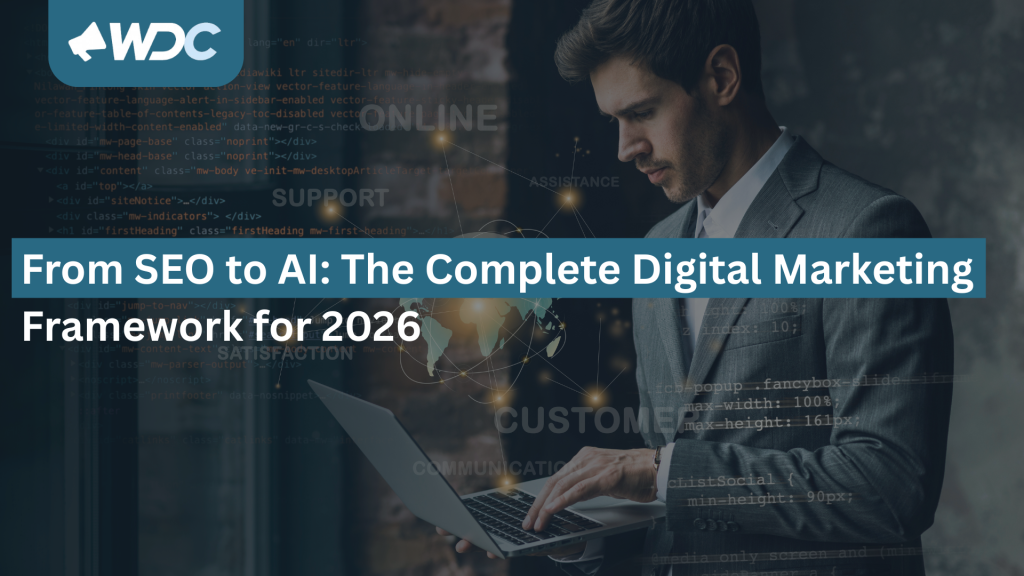
Digital marketing in 2026 has entered a new era. The days of relying on a single channel—whether SEO, social media, or paid ads—are over. Today, success depends on an integrated framework where SEO, AI, data, content, paid media, and user experience work together with precision.
As algorithms grow smarter and consumer behavior becomes more complex, businesses must adopt a structured, future-ready digital marketing framework. This guide explains how digital marketing truly works in 2026—from traditional SEO foundations to advanced AI-driven strategies—and how brands can stay competitive in an increasingly crowded digital landscape.
Understanding the Digital Marketing Shift in 2026
Digital marketing is no longer about visibility alone. It’s about relevance, authority, and trust.
Key changes shaping 2026:
- Search engines prioritize experience and intent
- AI tools are embedded across marketing platforms
- Audiences demand authenticity and personalization
- Competition is higher in every niche
- Data-driven decisions outperform assumptions
To succeed, businesses must move beyond tactics and adopt a complete digital marketing framework.
1. SEO in 2026: The Foundation Still Matters
Search Engine Optimization remains the backbone of digital marketing, but it has evolved significantly.
What SEO Looks Like in 2026
- Topical authority over single keywords
- Search intent optimization (informational, commercial, transactional)
- Entity-based SEO instead of keyword stuffing
- Experience-first content backed by real insights
- Local SEO dominance for service-based businesses
Google now evaluates content using Experience, Expertise, Authoritativeness, and Trust (E-E-A-T). Ranking is no longer about tricks—it’s about credibility.
Modern SEO Best Practices
- Create content clusters around core topics
- Publish long-form, in-depth articles
- Optimize for featured snippets and “People Also Ask”
- Strengthen internal linking
- Focus on quality backlinks, not quantity
SEO in 2026 is a long-term asset, not a quick win.
2. Content Marketing: Value Over Volume
Content is still king—but only when it serves a purpose.
High-Performing Content Types in 2026
- Educational blog posts
- How-to guides and tutorials
- Case studies and success stories
- Short-form video content
- Localized and niche-specific content
Every piece of content should aim to:
- Solve a problem
- Educate the audience
- Build trust
- Guide users toward action
Random posting is replaced by structured content ecosystems aligned with business goals.
3. AI in Digital Marketing: Smart Integration
Artificial Intelligence is one of the biggest forces reshaping digital marketing—but misuse can hurt more than help.
Where AI Works Best
- Keyword research and topic discovery
- Content outlines and optimization
- Ad copy testing
- Audience segmentation
- Predictive analytics
- Chatbots for lead qualification
What Doesn’t Work
- Fully AI-written blogs without human input
- Generic automated social posts
- Mass automation with no personalization
In 2026, AI enhances human creativity—it doesn’t replace strategy.
Many agencies, including wdc lahore, use AI as a support system to improve efficiency while maintaining originality and authenticity.
4. Paid Advertising: Precision Over Reach
Paid advertising has become more competitive and expensive—but also more powerful when done right.
Platforms That Perform in 2026
- Google Search Ads for high-intent users
- Meta Ads (Facebook & Instagram) with funnel-based creatives
- TikTok Ads for awareness and engagement
- LinkedIn Ads for B2B and high-ticket services
What Makes Ads Convert Now
- Clear value propositions in the first 3 seconds
- Short-form video creatives
- Conversion-optimized landing pages
- Retargeting warm audiences
- Continuous A/B testing
Vanity metrics like likes and impressions mean nothing without measurable ROI.
5. Social Media Marketing: Community First
In 2026, social media is no longer about chasing viral moments. It’s about building long-term relationships.
What Works Now
- Authentic brand storytelling
- Educational micro-content
- Consistent posting schedules
- Two-way communication (comments, DMs, polls)
- Relevant influencer collaborations
Platforms favor brands that keep users engaged—not those that post randomly.
6. Conversion Rate Optimization (CRO): Turning Traffic into Revenue
Driving traffic is only half the equation. CRO ensures that visitors actually convert.
Key CRO Elements in 2026
- Fast-loading websites
- Mobile-first design
- Clear calls-to-action
- Trust signals (reviews, testimonials, certifications)
- Simple forms and checkout flows
Even a small improvement in conversion rate can double revenue without increasing ad spend.
7. Email & WhatsApp Marketing: Still Highly Effective
Despite new platforms, email and WhatsApp remain powerful channels in 2026.
Best Practices
- Personalized messaging
- Behavior-based automation
- Educational and value-driven content
- Limited promotional messaging
- Clear opt-in compliance
When integrated with SEO and paid ads, these channels boost retention and lifetime value.
8. Data, Analytics & Tracking: Decisions Over Assumptions
Marketing without data is guessing—and guessing fails in 2026.
Essential Metrics to Track
- Cost per lead
- Conversion rate
- Customer acquisition cost
- Lifetime value
- Funnel drop-off points
Tools like GA4, Meta Pixel, and CRM systems allow marketers to optimize campaigns in real time.
9. Local SEO & Personal Branding: The Trust Advantage
People trust people more than faceless brands.
Local SEO, founder visibility, and personal branding are major competitive advantages—especially in markets like Pakistan.
Businesses that show:
- Real teams
- Real stories
- Real expertise
Consistently outperform generic competitors. This is why companies like WDC Lahore emphasize transparency and authority-building alongside performance marketing.
The Complete Digital Marketing Framework for 2026
To succeed in 2026, businesses must integrate:
- SEO for long-term visibility
- Content for authority
- AI for efficiency
- Paid ads for scalability
- CRO for profitability
- Data for decision-making
- Local and personal branding for trust
Digital marketing is no longer fragmented—it’s a connected system.
Conclusion:
Digital marketing in 2026 is no longer about isolated tactics or short-term wins. Success now depends on building a connected system where SEO, content, AI, paid advertising, data, and user experience work together toward measurable business goals. Brands that rely on outdated methods struggle to compete, while those adopting a structured, strategy-first framework gain long-term visibility, trust, and growth.
Frequently Asked Questions (FAQs)
1. Is SEO still important in 2026?
Yes. SEO remains one of the highest ROI channels when done with topical authority, quality content, and proper intent targeting.
2. How important is AI in digital marketing today?
AI is essential, but only as a support tool. Strategy, creativity, and human insight still drive real success.
3. Can small businesses compete with big brands?
Absolutely. With local SEO, niche targeting, and smart paid ads, small businesses can outperform larger competitors.
4. Which digital marketing channel delivers the fastest results?
Paid ads deliver quicker results, while SEO and content marketing provide long-term growth within 3–6 months.
5. What is the biggest mistake businesses make in 2026?
Focusing on tools instead of strategy. Without a clear framework, even the best tools fail